The $4 Gold Stella (1879–1880) The Four-Dollar Gold Stella is among the most famous pattern issues in United States numismatics. Struck in 1879 and 1880 at the suggestion of Hon. John A. Kasson, then U.S. minister to Austria, the coin was conceived as an international trade denomination—convertible into the gold ... Read More
The $4 Gold Stella (1879–1880)
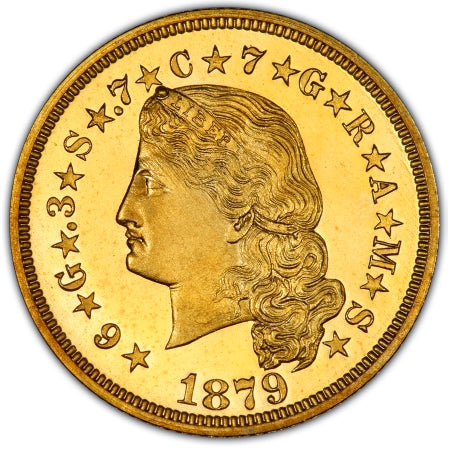
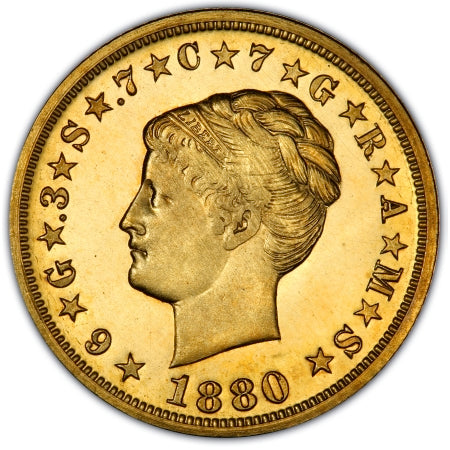
The Four-Dollar Gold Stella is among the most famous pattern issues in United States numismatics. Struck in 1879 and 1880 at the suggestion of Hon. John A. Kasson, then U.S. minister to Austria, the coin was conceived as an international trade denomination—convertible into the gold coinages of major European nations. Reflecting this purpose, the obverse legend lists its metallic composition in metric units: 6G .3S .7C 7 GRAMS, a blend of gold, silver, and copper approximating the value of four U.S. dollars.
Two distinct obverse designs were prepared: Flowing Hair, by Chief Engraver Charles E. Barber, and Coiled Hair, by Assistant Engraver George T. Morgan. The reverse features a five-pointed star, or stella, encircled by legends including DEO EST GLORIA (“God is Glorious”) in place of the traditional In God We Trust.
Although intended for possible circulation abroad, Stellas remained experimental and were distributed primarily to members of Congress. Estimated mintages are approximately 425 pieces for the 1879 Flowing Hair, 10 for the 1879 Coiled Hair, 15 for the 1880 Flowing Hair, and 10 for the 1880 Coiled Hair, though actual figures may be slightly higher. Today, the Stella stands as one of the most iconic pattern coins ever produced by the United States Mint—coveted for its beauty, historical significance, and legendary rarity.
...
Read Less